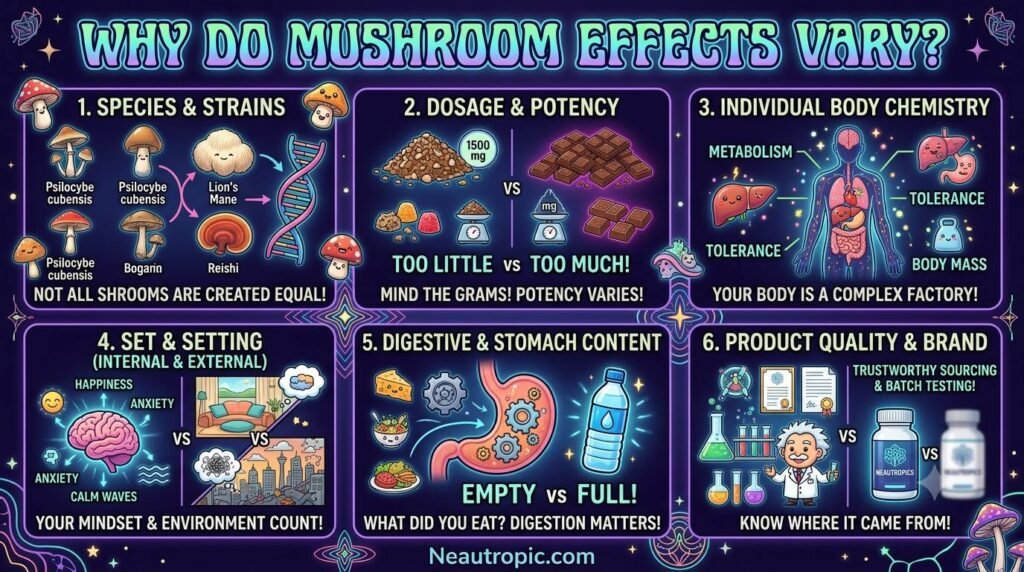
Why do mushroom effects vary? The simplest answer is that the experience depends on much more than the product alone. The active ingredients and amount consumed matter, but so do product consistency, digestion, metabolism, personal sensitivity, medications, expectations, mood, surroundings, and recent substance use.
That is why two people can consume the same type of mushroom edible and describe very different experiences—or why the same person may react differently on two separate occasions. Mushroom products are not predictable enough for someone else’s experience to function as a guaranteed preview of your own.
Why Do Mushroom Effects Vary So Much Between Products?
“Mushroom edible” is an unusually broad label. It may describe a product containing functional mushroom extracts, Amanita-derived compounds, psilocybin-related ingredients, proprietary blends, or substances that are not clearly identified on the packaging.
These products should not be assumed to have equivalent effects.
Even when two packages look similar, they may differ in:
- active ingredients;
- amount per serving;
- manufacturing consistency;
- ingredient distribution;
- additional compounds;
- formulation and edible format;
- accuracy of the label.
This is particularly important because CDC investigations have identified undisclosed psilocybin and psilocin in products marketed as mushroom-containing nootropic gummies. A separate outbreak investigation also connected mushroom-containing chocolate products with severe illnesses, showing why attractive packaging or “microdose” language cannot replace transparent formulation and testing.
The Amount Consumed Influences Intensity
Dose is one of the clearest influences on psychedelic effects. Controlled studies show a dose-response relationship in which larger measured psilocybin doses generally produce stronger subjective changes, including more noticeable alterations in perception and consciousness. (PubMed)
However, a label such as “one piece” does not reveal much unless the active ingredient and quantity per piece are clearly stated.
A large chocolate square may contain less of an active compound than a small gummy. Similarly, “500 mg mushroom blend” may describe the weight of a mixed extract rather than the amount of psilocybin or another specific psychoactive ingredient.
The word “microdose” is not a universal measurement either. Our explanation of what a microdose amount is covers why research quantities, dried mushroom weight, chocolate segments, gummies, and proprietary blends cannot be treated as interchangeable.
Equal Portions May Not Always Be Equal
A package may appear to offer identical servings, but consistency depends on the manufacturing process. Active ingredients must be accurately measured and evenly distributed throughout the finished product.
If the mixture is not homogeneous, two gummies or chocolate squares from the same package could potentially contain different amounts. Ingredient degradation, poor storage, production errors, and inaccurate labelling can create further variation.
This is one reason quality should not be judged solely by branding, flavour, or a large potency number. More useful signs include:
- a complete ingredient list;
- a clearly stated amount per serving;
- identifiable batch information;
- current finished-product testing;
- realistic warnings;
- clear storage guidance.
The format itself is less important than what the edible contains and how reliably it was produced.
Your Body Changes the Timeline
After an oral product is swallowed, it must be digested and absorbed. Psilocybin, when present, is converted into the active compound psilocin, which is then processed and eliminated by the body.
Clinical research has found meaningful variation in absorption timing. A recent review reported that maximum psilocin concentrations after oral psilocybin occurred approximately 1.05 to 3.71 hours after administration, with many study results centred near two hours.
Commercial mushroom edibles are not equivalent to pharmaceutical psilocybin used in controlled research, but the research helps explain why onset is not identical for everyone.
Timing may be influenced by:
- digestive speed;
- recent meals;
- individual metabolism;
- product formulation;
- other substances;
- certain medications;
- general physical condition.
Interestingly, body weight alone may not predict the response as reliably as many people assume. Controlled studies have found that fixed dosing can be practical and that body weight did not significantly influence psilocybin pharmacokinetics or subjective response in the studied participants.
A Slow Start Can Be Misread as a Weak Experience
One person may notice early effects quickly, while another may experience a much slower build. The first changes can also be subtle enough to overlook.
Early signs may involve:
- increased awareness of music or lighting;
- a different sense of time;
- changes in emotional sensitivity;
- unusual thought patterns;
- relaxation or restlessness;
- mild stomach sensations;
- greater awareness of the body.
Someone expecting immediate visual changes may conclude that nothing is happening, even though the experience has already begun developing.
Our guide explaining how long before mushroom chocolate hits examines the difference between initial onset, the gradual build, and the later peak. That distinction matters because taking more during a delayed onset can make the eventual experience considerably stronger than intended.
Mindset Can Change How the Same Effects Feel
A person’s mental and emotional state is commonly described as their “set.” Stress, excitement, expectations, fear, confidence, and previous experiences can all influence how unusual sensations are interpreted.
For example, increased emotional sensitivity might feel meaningful and interesting to someone who feels calm. The same change could feel unsettling to someone who is already anxious or overwhelmed.
Expectations can influence perception as well. In a placebo study conducted in a psychedelic-style environment, some participants reported substantial subjective effects despite not receiving an active psychedelic substance. The results illustrate how suggestion and context can affect what people notice and how they describe it.
This does not mean psychedelic effects are imaginary. It means the pharmacological effects occur alongside powerful psychological influences.
Surroundings Matter More Than People Expect
“Setting” refers to the physical and social environment in which an experience occurs.
A familiar, quiet room with trusted company can feel completely different from a crowded venue, unfamiliar house, stressful journey, or noisy public space. Lighting, music, privacy, social pressure, and the behaviour of other people may all shape the experience.
Scientific literature recognizes substantial variation both between different individuals and within the same individual, with environmental context considered an important possible explanation.
This is also why experiences from clinical research should not be directly compared with unsupervised retail-product use. Research participants are commonly screened, given measured compounds, prepared beforehand, and supported in controlled environments.
Gummies and Chocolate Can Create Different Expectations
The comparison between mushroom gummies vs chocolate is often presented as though each format has one characteristic experience. In reality, neither format is automatically stronger or faster.
Gummies may feel easier to count because they come as separate pieces. Chocolate may feel more dessert-like and can mask earthy ingredients well. Those practical differences can affect how someone approaches the product, but they do not override ingredient identity, active amount, consistency, and individual response.
The format may influence digestion to some degree, yet there is no reliable rule stating that every gummy works faster than every chocolate bar—or the reverse.
The Same Person Can Have Different Experiences
Previous experience does not guarantee that the next occasion will feel identical.
From one day to another, a person’s response may be affected by:
- sleep quality;
- stress and mood;
- recent food intake;
- surroundings;
- expectations;
- product batch;
- medications or supplements;
- alcohol, cannabis, or other substances;
- time since previous psychedelic exposure.
Even when several variables appear similar, the subjective experience may still differ. Psychedelic effects involve changes in mood, perception, thought, and sense of self, making them especially sensitive to context.
Other Substances Can Make Effects Less Predictable
Combining a mushroom edible with alcohol, cannabis, medication, or another psychoactive substance makes it more difficult to predict both intensity and safety.
The substances may interact pharmacologically, or one may make the effects of another harder to interpret. Someone could also mistakenly blame the mushroom product for an effect created by the combination.
Medication-related questions should be discussed with a qualified healthcare professional rather than answered through online anecdotes. Current research on psilocybin metabolism also highlights the possibility of drug interactions and the need for further study.
Comparing a Specific Gummy Product
When researching a particular product, review its own information instead of applying assumptions from another flavour, format, or brand.
The Neautropics Strawberry Kiwi Gummies page is the relevant place to check the current product description and purchasing information for that option. The physical packaging should still be reviewed for the latest ingredient list, serving details, warnings, and storage instructions.
A positive review from another person can describe their experience, but it cannot confirm how your body will respond or verify the contents of a different batch.
When Variation Becomes a Safety Concern
Variation does not only mean that one experience may be stronger or milder. Unexpected effects can sometimes become uncomfortable or medically concerning.
Possible adverse effects associated with psilocybin include nausea, headache, dizziness, anxiety, panic, confusion, increased heart rate, and changes in blood pressure. More serious psychological reactions can occur, especially in vulnerable individuals or unpredictable circumstances. The NCCIH guidance on psilocybin and its possible risks provides a balanced overview of current research and safety concerns.
Seek urgent medical assistance when someone develops symptoms such as seizures, loss of consciousness, breathing difficulty, chest pain, repeated vomiting, extreme agitation, severe confusion, or behaviour that creates immediate danger.
Final Thoughts
So, why do mushroom effects vary? The experience is shaped by the active compound, amount consumed, product consistency, edible formulation, digestion, metabolism, personal sensitivity, mental state, surroundings, and any other substances involved.
No single review, serving size, product format, or previous experience can guarantee what will happen next time.
The most useful approach is to read the exact product information, avoid assuming that delayed effects mean weak effects, remain cautious about poorly disclosed ingredients, and treat dramatic marketing claims with scepticism. With mushroom edibles, transparency and predictability matter far more than flavour, packaging, or promises of maximum strength.