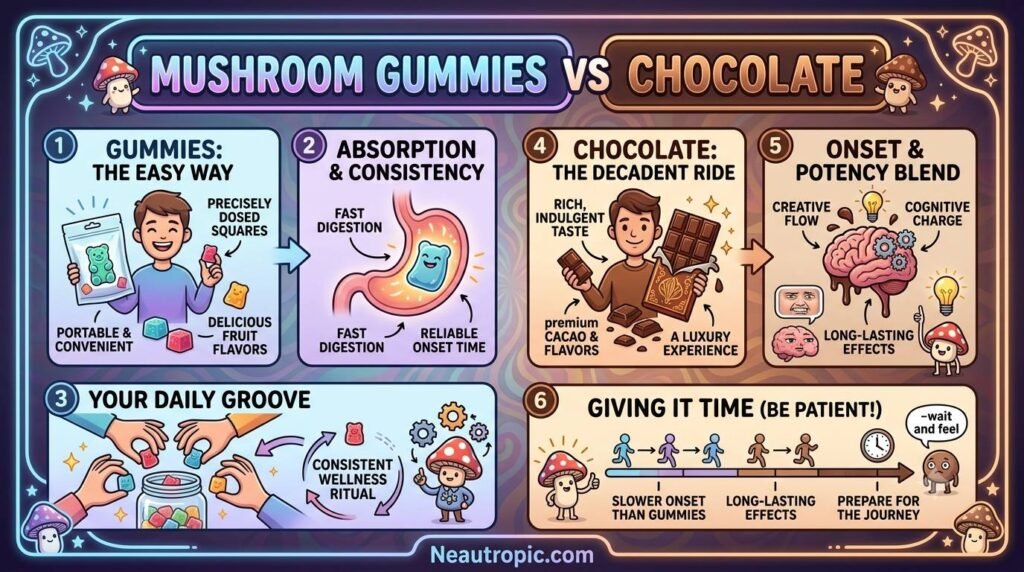
When comparing mushroom gummies vs chocolate, neither format is automatically stronger, faster, or more effective. Gummies are often preferred for portability, fruit flavour, and easy piece-by-piece portioning, while chocolate bars appeal to people who enjoy a richer taste and a more traditional dessert-style experience.
The better choice depends on what the product contains, how clearly each serving is labelled, dietary preferences, storage conditions, and how you prefer to consume an edible. Format matters, but the active ingredients and consistency of the formulation matter much more.
Mushroom Gummies vs Chocolate at a Glance
The physical difference is straightforward: gummies are soft, chewy, and usually divided into individual pieces, while mushroom chocolate is typically moulded into a segmented bar.
In practical terms, gummies tend to be:
- easier to carry without attracting attention;
- available in bright fruit flavours;
- individually portioned;
- less likely to melt in warm conditions;
- simple to count and track.
Chocolate bars tend to offer:
- a richer and more familiar dessert experience;
- segmented squares for portioning;
- greater flavour variety;
- a smoother way to mask earthy ingredients;
- packaging that feels similar to conventional chocolate.
These differences may affect convenience and enjoyment, but they do not reveal how potent or predictable a product will be.
Is One Format Stronger?
A gummy is not naturally weaker than a piece of chocolate, and chocolate is not inherently more powerful than a gummy.
Strength depends primarily on:
- the active ingredient;
- the quantity present in each serving;
- how evenly it is distributed;
- formulation consistency;
- individual sensitivity;
- whether the label accurately represents the contents.
A small gummy could contain more of an active compound than a large chocolate square, or the opposite could be true. Physical size, flavour intensity, and package design are poor ways to judge potency.
The phrase “mushroom edible” is also broad. Products may contain functional mushroom extracts, Amanita-derived ingredients, psilocybin-related compounds, nootropic blends, or substances that are not clearly disclosed. These categories should not be treated as interchangeable.
CDC investigations have found undisclosed psychoactive substances in some mushroom gummies and documented serious illness associated with certain mushroom-containing chocolate products. This makes clear labelling and reliable finished-product testing more important than choosing between gummy and chocolate alone.
Which One Starts Working Faster?
There is not enough reliable evidence to say that mushroom gummies consistently take effect faster than mushroom chocolate, or vice versa.
Both are swallowed and must pass through digestion before orally active ingredients can be absorbed. Their onset may therefore depend on the formulation, serving amount, recent meals, individual physiology, and actual compounds present.
Chocolate contains fat, while gummies are generally made with sugar, flavouring, and a gelling ingredient. Those differences may influence digestion, but they do not create a dependable rule that applies to every product and every person.
Anyone considering the chocolate format should read how long before mushroom chocolate hits for a more detailed explanation of onset, subtle early effects, and why the experience may continue building after it first becomes noticeable.
Controlled oral-psilocybin research has found that psilocin concentrations often peak around two hours after administration, but measured clinical doses are not directly equivalent to retail mushroom gummies or chocolate bars.
Portioning: Gummies Can Be Simpler, but Labels Still Matter
Gummies are usually presented as individual pieces, which can make them easier to count. Someone can clearly see whether they have taken one piece or several.
Chocolate bars are commonly divided into squares, but the number of squares does not automatically tell you how much active ingredient each one contains. The total amount may be distributed across the entire bar, and the serving information must be read carefully.
Even apparently convenient portioning has limitations. It depends on:
- accurate manufacturing;
- even ingredient distribution;
- clear amounts per piece;
- realistic serving instructions;
- trustworthy batch information.
A product marketed as a “microdose gummy” does not automatically contain a standardized microdose. Our guide explaining what a microdose amount is covers why dried mushrooms, purified psilocybin, proprietary blends, gummies, and chocolate cannot be compared using one universal number.
Taste and Texture May Decide the Winner
For many buyers, the most noticeable difference between mushroom gummies and chocolate is not potency—it is taste.
Gummies often use flavours such as strawberry, kiwi, peach, berry, or citrus. They can feel lighter and are convenient for people who do not want a rich snack.
Chocolate may be more effective at covering bitter or earthy flavours. Milk chocolate, dark chocolate, birthday cake, mint, and peanut-butter-style bars can make the format feel more like a dessert.
However, taste can also make an edible deceptively easy to consume. A pleasant flavour does not turn a potentially psychoactive product into ordinary candy. It should still be stored securely and kept away from children, pets, and anyone who does not understand what it contains.
Portability and Storage
Gummies are usually the more practical option for warm weather. They may soften or become sticky, but they are less prone to becoming completely liquid than chocolate.
Chocolate requires greater temperature control. It can melt inside a vehicle, bag, pocket, or delivery package. Repeated melting and cooling may also affect appearance and make the original segments harder to distinguish.
At home, both formats should remain:
- in their original packaging;
- protected from excessive heat and moisture;
- clearly labelled;
- separated from ordinary snacks;
- inaccessible to children and pets.
Storage instructions on the packaging should take priority because ingredients and formulations vary.
How the Experiences May Be Perceived
Some people describe chocolate as smoother or more gradual, while others find gummies more predictable. These descriptions are personal observations, not dependable scientific differences between the two formats.
Expectations can shape how an experience is interpreted. Someone who associates chocolate with relaxation may describe it differently from a bright, fruit-flavoured gummy, even when the underlying active amount is similar.
The article on Neautropics mushroom chocolate effects explores how mood, sensory awareness, personal sensitivity, environment, formulation, and expectations can influence what someone notices.
The exact effects still depend on the specific ingredients. Neither “gummy” nor “chocolate” is a complete description of what the product does.
Dietary Differences Worth Checking
The ingredient list may make one format more suitable than the other.
Chocolate products may contain:
- milk or other dairy ingredients;
- soy lecithin;
- nuts or shared-facility allergens;
- cocoa;
- added sugar.
Gummies may contain:
- gelatin;
- pectin;
- glucose syrup;
- artificial or natural colours;
- flavouring ingredients;
- added sugar.
People following vegan, dairy-free, gluten-free, or allergen-conscious diets should inspect the exact label rather than assuming all gummies or chocolates follow the same recipe.
How to Compare Products Responsibly
Instead of asking only whether gummies or chocolate are better, compare the information available for each product.
Look for:
- A clear ingredient list
- The active amount per serving
- The total number of servings
- Current batch-testing information
- Allergen and dietary details
- Storage instructions
- Realistic warnings and claims
Be cautious when a product relies on phrases such as “proprietary mushroom blend” without explaining what the blend contains. In 2024 testing, CDC investigators found that several retail mushroom gummies contained ingredients not disclosed on their labels. The CDC report on substances identified in mushroom gummies provides important context on why front-label marketing should not replace ingredient transparency.
Choosing a Gummy Product
Gummies may be the better choice for someone who values fruit flavour, portability, and an easy-to-count format.
Shoppers considering this option can review the Neautropics Strawberry Kiwi Gummies page for its current product description and available purchasing details. The physical packaging should also be checked for the latest ingredients, serving information, warnings, and storage directions. The page currently describes a strawberry-and-kiwi-flavoured gummy format.
Final Verdict: Mushroom Gummies or Chocolate?
In the mushroom gummies vs chocolate comparison, gummies generally win for portability, fruit flavour, warm-weather convenience, and straightforward piece counting. Chocolate may be preferable for richer flavour, dessert appeal, and its ability to mask earthy ingredients.
Neither format is automatically stronger, safer, or faster.
The best choice is the product that clearly identifies its ingredients, explains the amount in each serving, provides reliable quality information, and fits your dietary and storage needs. Choose based on transparency and consistency—not package size, bold potency claims, or the assumption that one edible format always produces a particular experience.