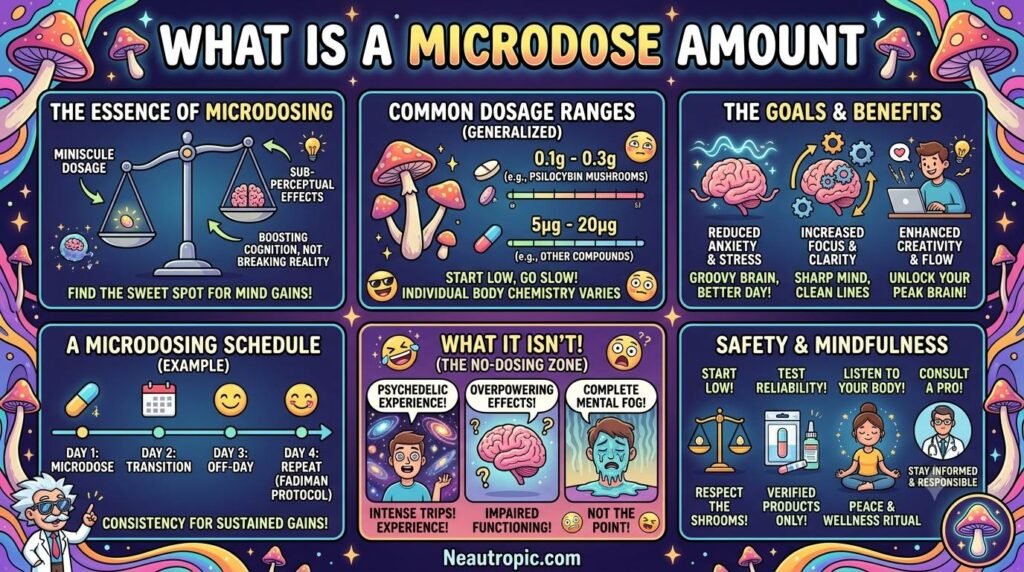
What is a microdose amount? A microdose is generally described as a very small amount of a psychedelic substance—often around 5% to 10% of a full dose—intended to remain below the level that produces an obvious psychedelic experience. However, there is no universally standardized microdose for mushrooms, chocolates, or gummies.
That distinction matters. A measured amount of pure psilocybin used in clinical research is not equivalent to the same weight of dried mushrooms, chocolate, or a commercial mushroom blend. Potency, formulation, labeling accuracy, personal sensitivity, and product ingredients can all change what a “small” amount actually feels like.
What Is a Microdose Amount in Practical Terms?
The National Institute on Drug Abuse defines microdosing as regularly consuming a small amount of a psychedelic substance, usually approximately 5% to 10% of a typical full dose. The goal generally associated with microdosing is to avoid the major perceptual changes expected from a conventional psychedelic dose. See NIDA’s scientific overview of psilocybin and microdosing for additional context.
Published studies have used different amounts rather than one accepted standard. For example, one placebo-controlled study examined 0.5 grams of dried psilocybin-containing mushrooms, while a newer clinical-trial protocol describes 2 milligrams of purified psilocybin as a microdose. These are research protocols, not universal consumer recommendations.
The important answer is therefore not one fixed number. A microdose is better understood as a low, product-specific amount expected to remain below a full psychedelic experience.
Why Mushroom Weight Can Be Misleading
People often search for a simple answer in grams, but dried mushroom weight is an imperfect way to predict active strength.
Scientific literature indicates that psilocybin content can differ substantially among mushroom species, strains, batches, and individual samples. One clinical review reported approximate concentrations ranging from 0.5% to 2% of dried mushroom weight. That means two portions of equal weight may contain meaningfully different amounts of psilocybin.
Commercial edibles create additional uncertainty because the amount printed on the package may refer to:
- the total mushroom-blend weight;
- the weight of the entire chocolate or gummy;
- a functional-mushroom extract;
- a proprietary mixture;
- or a measured psychoactive ingredient.
These figures are not interchangeable. A label stating “500 mg mushroom blend” does not necessarily mean that the product contains 500 mg of psilocybin.
Microdose Does Not Always Mean Unnoticeable
Microdosing is often called “sub-perceptual,” but that description can be confusing. A person may not experience obvious visual distortions while still noticing changes in mood, energy, focus, physical sensations, or anxiety.
In a double-blind study using 0.5 grams of dried mushrooms, participants experienced more noticeable acute effects with the active product than with placebo. The study did not find significant improvements in creativity, cognition, physical activity, or overall well-being, and some cognitive measures showed a trend toward impairment.
A true microdose should not be treated as harmless simply because it is small. Even low amounts can affect attention, judgment, emotional state, or coordination in some people.
Product Format Changes How the Amount Is Interpreted
A piece of chocolate, one gummy, and a measured quantity of dried mushrooms cannot automatically be compared by physical size.
Chocolate and gummy products may divide their ingredients across several portions. Whether each portion is consistent depends on how the product was manufactured and how evenly its ingredients were distributed.
Anyone considering chocolate should first understand how long before mushroom chocolate hits. A slow onset does not necessarily mean the amount was too small, and the first effects may continue building after they become noticeable.
The product’s specific effect profile is equally important. The guide to Neautropics mushroom chocolate effects explains how mood, surroundings, personal sensitivity, formulation, and expectations can influence the experience beyond the number printed on a label.
Delayed Effects Are Not a Reason to Take More
One of the most common mistakes is deciding that a portion was ineffective before digestion and absorption are complete.
Someone may consume a small amount, notice nothing immediately, and assume that increasing it is the logical next step. If the original portion is still developing, the combined effect may eventually become much stronger than intended.
Our explanation of why effects feel delayed covers the difference between a genuinely late onset and subtle early changes that are easy to overlook.
Regardless of how a product is marketed, avoid using impatience as a measuring tool. Follow the label, do not drive or operate equipment after consuming a potentially psychoactive product, and avoid combining it with alcohol or other intoxicants.
Is There Evidence That Microdosing Works?
Research remains mixed, and many popular benefits have not been confirmed conclusively.
People commonly claim that microdosing improves creativity, mood, productivity, or mental clarity. Observational studies have sometimes found positive self-reported outcomes, but these designs cannot fully separate pharmacological effects from expectations, lifestyle differences, and placebo effects.
Placebo-controlled research has produced more cautious results. One trial found no significant improvement in emotional processing or symptoms of anxiety and depression compared with placebo. A 2024 scientific review concluded that firm conclusions about the effectiveness of psilocybin microdosing remain unavailable because the evidence is limited and inconsistent.
Microdosing should therefore not be presented as a proven treatment for depression, anxiety, attention problems, or another medical condition.
A Small Amount Can Still Produce Unwanted Effects
Reported unwanted effects of psilocybin microdosing include anxiety, poor mood, insomnia, physical discomfort, gastrointestinal symptoms, headaches, reduced focus, and altered sensory experiences. Psilocybin may also be particularly unsafe for people with psychotic disorders or certain severe psychiatric conditions.
Extra caution is necessary when:
- the ingredients or active amounts are unclear;
- no reliable batch-testing information is available;
- the product will be combined with other substances;
- prescription medications are involved;
- the person has a history of severe psychiatric symptoms;
- driving, work, childcare, or safety-sensitive responsibilities are planned.
Clinical psilocybin research generally involves screening, carefully measured substances, controlled environments, and professional supervision. Consuming an ordinary retail edible is not equivalent to participating in that research.
Understanding Product Information Before Buying
The most useful label is one that clearly identifies the active ingredients, amount per portion, total portions, relevant warnings, and available testing information. Vague phrases such as “proprietary mushroom blend” make it harder to understand what a microdose amount represents.
Businesses researching product formats and larger-order options can review the Neautropics Gummies Wholesale page for its current product and purchasing information. The physical packaging and latest product documentation should still be checked before sale or consumption.
Final Answer: What Is a Microdose Amount?
A microdose is commonly defined as roughly 5% to 10% of a full psychedelic dose, but there is no single standardized amount that applies to every mushroom, gummy, or chocolate product. Research has examined amounts such as 0.5 grams of dried mushrooms and 2 milligrams of purified psilocybin, but these study quantities should not be converted into personal instructions.
The correct interpretation depends on the active ingredient—not merely the total weight of a chocolate square, gummy, or mushroom blend. Product potency can vary, effects may be delayed, and even a small amount can produce noticeable or unwanted changes.
Treat “microdose” as a product-specific description rather than a guarantee of safety, consistency, or therapeutic benefit.