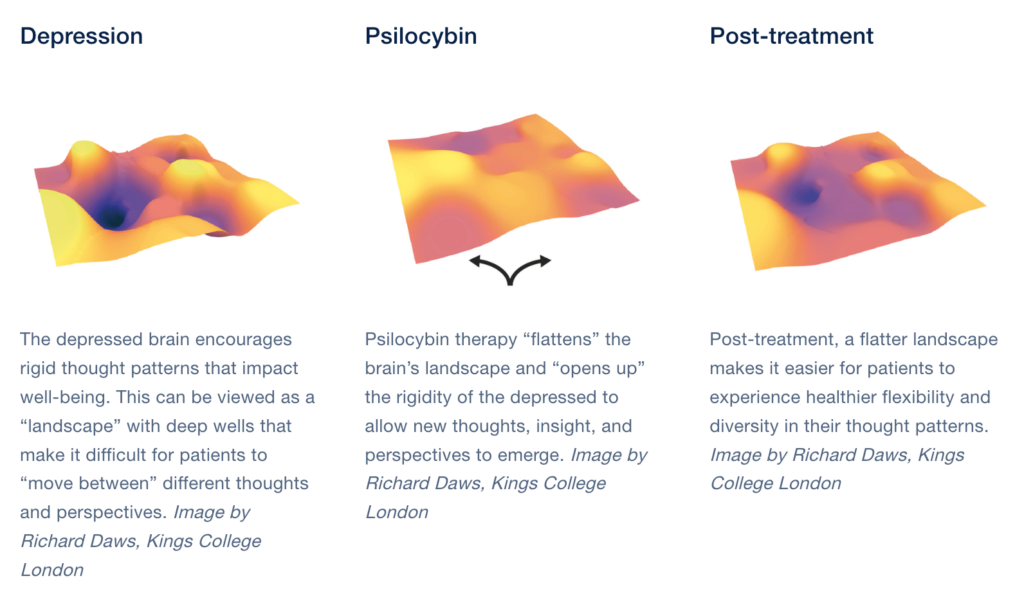
Many readers ask how psilocybin affects the brain and why neuroscientists continue to study this compound. Psilocybin is a naturally occurring substance found in certain mushroom species. After ingestion, the body converts it into psilocin, which interacts with serotonin receptors in the brain. Because these receptors regulate mood, perception, and cognition, researchers study how psilocybin affects the brain to better understand neural communication and sensory processing.
How Psilocybin Affects the Brain Through Serotonin Receptors
First, the body converts psilocybin into psilocin. Then psilocin interacts with serotonin receptors, especially the 5-HT2A receptor. This interaction influences how neurons communicate across brain networks.
As a result, signals between brain regions may change temporarily. Consequently, researchers observe differences in perception, emotional interpretation, and cognitive flexibility.
To understand the receptor involved in this process, see:
https://neautropic.com/what-is-the-5ht2a-receptor/
How Does Psilocybin Affect the Brain Communication Networks
Researchers studying how psilocybin affects the brain often examine neural communication patterns. Normally, brain regions communicate in stable networks. However, some studies suggest that psilocybin may temporarily alter how these networks interact.
For example, researchers frequently study the default mode network (DMN). This network influences self-reflection and internal thought processes. When communication within this network changes, the brain may process information differently.
How Psilocybin Affects Perception and Sensory Processing
Another reason scientists study how psilocybin affects the brain relates to perception. Brain networks process visual, emotional, and sensory signals together. When communication patterns shift, the brain may interpret information in new ways.
Therefore, researchers often analyze how perception changes during controlled studies. These observations help scientists understand how neural circuits influence awareness and sensory interpretation.
For a deeper explanation of perception changes, see:
https://neautropic.com/how-does-psilocybin-change-perception/
Brain Adaptation and Neuroplasticity
Scientists also investigate whether psilocybin affects neuroplasticity, the brain’s ability to form new neural connections. Neuroplasticity supports learning, memory, and emotional adaptation.
Because neural networks constantly reorganize themselves, researchers study how different neurotransmitter systems influence this process. Understanding neuroplasticity helps scientists examine how brain networks adapt to new experiences.
To explore this topic further, read:
https://neautropic.com/what-is-neuroplasticity-and-how-is-it-linked-to-psilocybin/
Scientific Research on Brain Activity
Modern neuroscience uses brain imaging techniques such as functional MRI to study neural activity. These tools allow scientists to observe communication between brain regions in real time.
Research institutions such as Johns Hopkins University and Imperial College London have conducted important studies examining brain connectivity and perception.
You can explore peer-reviewed research through:
https://pubmed.ncbi.nlm.nih.gov/?term=psilocybin+brain
Why Scientists Continue Studying Brain Effects
Scientists continue studying how psilocybin affects the brain because it provides insight into neural communication, perception, and cognitive processing. By examining how neurotransmitters interact with brain networks, researchers improve their understanding of human consciousness and mental processes.
As neuroscience advances, researchers gain new tools to explore how brain chemistry influences perception, cognition, and emotional regulation.
Frequently Asked Questions
How does psilocybin affect the brain chemically?
Psilocybin converts into psilocin in the body. Psilocin interacts with serotonin receptors, which influence neural communication and perception.
Does psilocybin change brain activity?
Research suggests that it may temporarily alter communication between certain brain networks, including those involved in perception and self-reflection.
Why do scientists study how psilocybin affects the brain?
Researchers study this compound to better understand brain chemistry, neural networks, and how perception and cognition work.