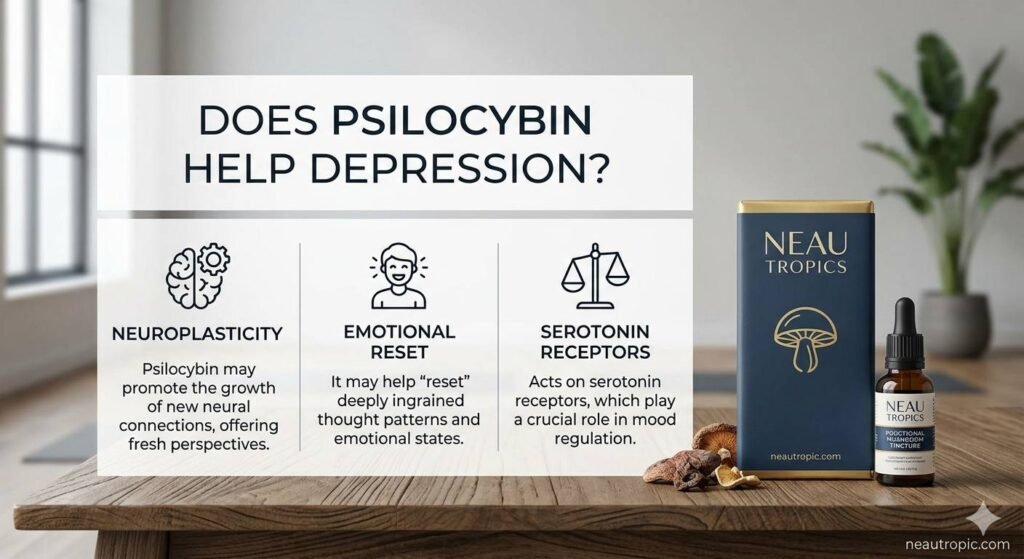
If you’re asking does psilocybin help depression, the honest answer is: there is growing evidence that it can help in certain controlled settings, but it’s not a simple or universal solution.
Interest in psilocybin has increased because some studies show promising results for people dealing with treatment-resistant depression. At the same time, how it works—and whether it works for you—depends heavily on context, mindset, and how it’s used.
What Current Research Actually Says
In clinical settings, psilocybin has been studied as part of guided therapy. Some findings suggest:
- rapid improvement in mood for some individuals
- changes in thought patterns and emotional processing
- effects that may last beyond the immediate experience
You can explore clinical research on psilocybin and depression treatment outcomes to understand how structured use differs from casual use.
What’s important here is that these results come from controlled environments, not everyday, unsupervised use.
Why Psilocybin May Affect Depression
One of the key ideas behind psilocybin’s effects is that it can temporarily shift how the brain processes information.
Instead of reinforcing the same negative thought loops, it may:
- disrupt rigid patterns
- increase openness in thinking
- allow different emotional perspectives
Some people describe this as a “reset” feeling, though that’s a simplified explanation.
Does Psilocybin Help Depression for Everyone?
No—and this is where most misunderstandings happen.
It may help some people, but outcomes vary depending on:
- mental state going in
- environment during the experience
- expectations
- dosage and timing
This is not something that works automatically or consistently across all situations.
The Role of Dosage and Timing
Even outside clinical settings, how psilocybin is used matters a lot.
Taking too much too quickly, or without understanding timing, can lead to overwhelming experiences rather than helpful ones. That’s why topics like how much mushroom gummies should I take and how long do mushroom gummies take to kick in are important—they directly affect how the experience unfolds.
Potential Risks to Be Aware Of
Psilocybin isn’t risk-free.
Some people may experience:
- anxiety or discomfort
- confusion during the experience
- intensified emotions
There are also concerns about lingering perceptual effects in rare cases, which are discussed in can psilocybin cause flashbacks.
Understanding these possibilities helps you approach the topic more realistically.
Context Matters More Than the Substance Alone
A key takeaway from both research and real-world experiences is that psilocybin doesn’t act in isolation.
The outcome is influenced by:
- your mental state
- your environment
- your expectations
- how prepared you are
This is why structured, guided settings in research tend to produce more consistent results than unstructured use.
Where Products Fit Into the Conversation
For people exploring different formats, products like the Neautropics Monday Espresso Bar product page show how psilocybin-related experiences are often packaged into controlled portions.
However, it’s important to understand that format doesn’t replace context or preparation. The way something is used matters more than how it’s delivered.
Final Thoughts
So, does psilocybin help depression?
It can, in some cases—but it’s not a guaranteed or simple solution.
What stands out most from both research and real-world use is this:
- outcomes depend heavily on context
- mindset and preparation matter
- responsible use is essential
Approaching this topic with realistic expectations—and a clear understanding of both potential benefits and risks—is what makes the difference.